

How To Register Investment In Taxes
Nigh Canadians take advantage of revenue enhancement sheltering inside a Registered Retirement Savings Plan (RRSP) or through the tax-free benefits of a Tax-Gratis Savings Account (TFSA). Even so, outside of registered accounts, revenue enhancement efficiency plays a key function in building wealth.
Tax efficiency is a key consideration in maximizing investment returns after taxes.
Dividends and capital gains receive preferential revenue enhancement treatment relative to interest income.
Building an effectively diversified portfolio with tax efficiency in mind is a key mode to building wealth and accelerate growth over time.
These income types are taxed differently past the Canada Revenue Agency. For instance, like wages, interest income typically earned on such investments as Guaranteed Investment Certificates (GICs) or savings deposit accounts is taxed at an individual's highest marginal tax rate, making information technology the least efficient form of investment income. Past contrast, dividends paid on stocks issued by eligible Canadian corporations receive more than favourable taxation treatment, since this type of income benefits from the federal dividend tax credit. In other words, dividend income is more than revenue enhancement-efficient than interest income, which ultimately ways that investors in dividend-paying investments keep more of what they earn afterward taxes.
Capital gains materialize when y'all sell your investment for a higher price than what you paid for it. This divergence is recognized as taxable income. Equally highlighted in the chart beneath, similar to dividend income, capital gains also receive relatively favourable tax treatment, since only half of the capital proceeds is discipline to taxation. Dividends and capital gains are typically earned on equity investments.
It'southward what you lot keep after revenue enhancement that matters
For illustrative purposes only. Assumes a marginal tax charge per unit of 26%. Delight note that tax rates are unique to the circumstances of each individual and province they alive in. Tax rates are field of study to change. * Includes just the Federal Dividend Tax Credit. † Represents eligible Canadian dividends. Notation: All figures are rounded to the nearest whole number.
Afterwards-tax returns illustrate your investment returns minus taxes. But put, if the one-twelvemonth rate of render on an investment is 8% and an investor had a marginal tax charge per unit of 26%, and so the afterwards-tax rate of return would be 5.ix%.
Achieving revenue enhancement efficiency inside an investment portfolio is not just a strategy for people who need cash flow today. If your investment programme includes long-term goals, like a comfortable retirement, minimizing the corporeality of taxes you pay on your investments tin accept a tremendous touch on your portfolio over time. That is why edifice an finer diversified portfolio — one that includes the appropriate mix of greenbacks, stock-still income and equities according to your investment objectives — is key to building wealth and accelerating growth over time. The types of investments you own and whether you concur them inside of or exterior of registered plans (RRSPs and TFSAs) can take a begetting on the tax efficiency of your overall portfolio and, ultimately, on your power to achieve your fiscal goals.
Three hypothetical portfolios and how they compare from a tax-efficiency standpoint
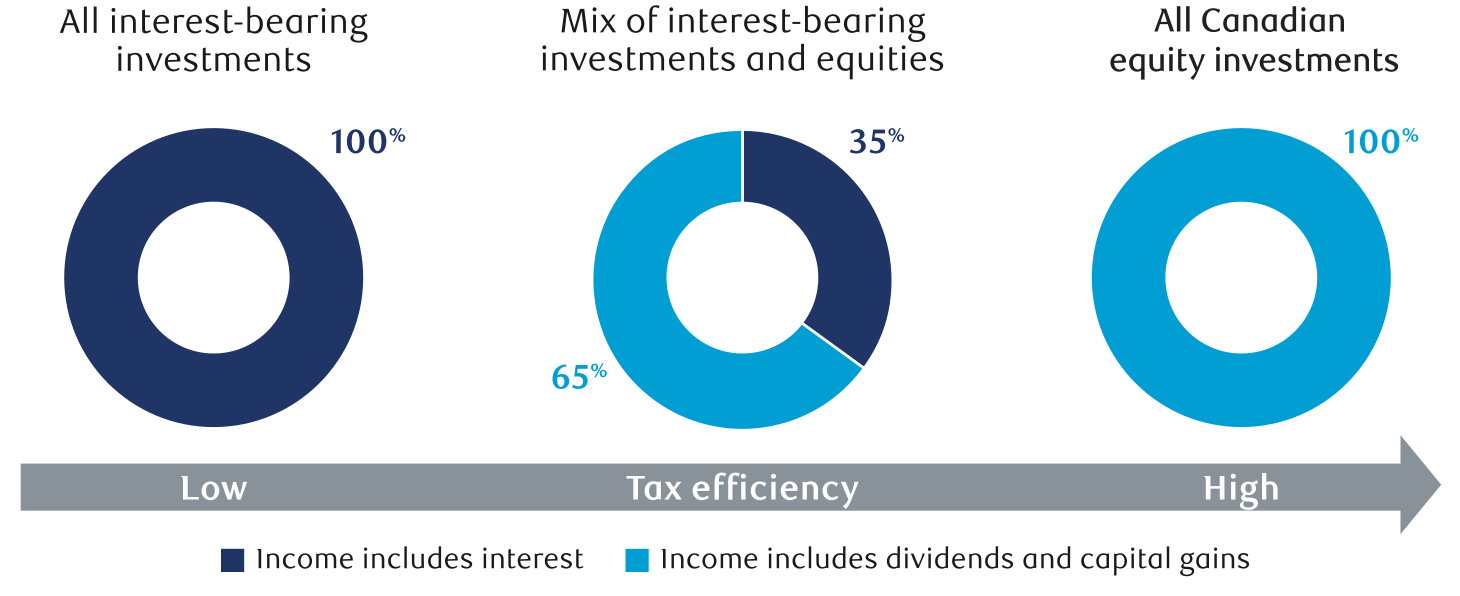
The following table provides a brief description of some of the dissimilar types of distributions that investors may receive from mutual funds and how each type is taxed.
What are the different types of distributions?
Here are descriptions of the different types of distributions you may receive from a mutual fund and how they are taxed.
Yous tin stay on track to see your long-term goals by building a tax-efficient investment portfolio with your advisor.

Source: https://www.rbcgam.com/en/ca/learn-plan/investment-basics/understanding-taxes-and-your-investments/detail
Posted by: rivashoon1958.blogspot.com
0 Response to "How To Register Investment In Taxes"
Post a Comment